Concrete Ordering Checklist: Quantities, Delivery and Costs
Prepare a US concrete order with a volume worksheet, allowance check, supplier questions and delivery details. Copy the checklist into your job notes.
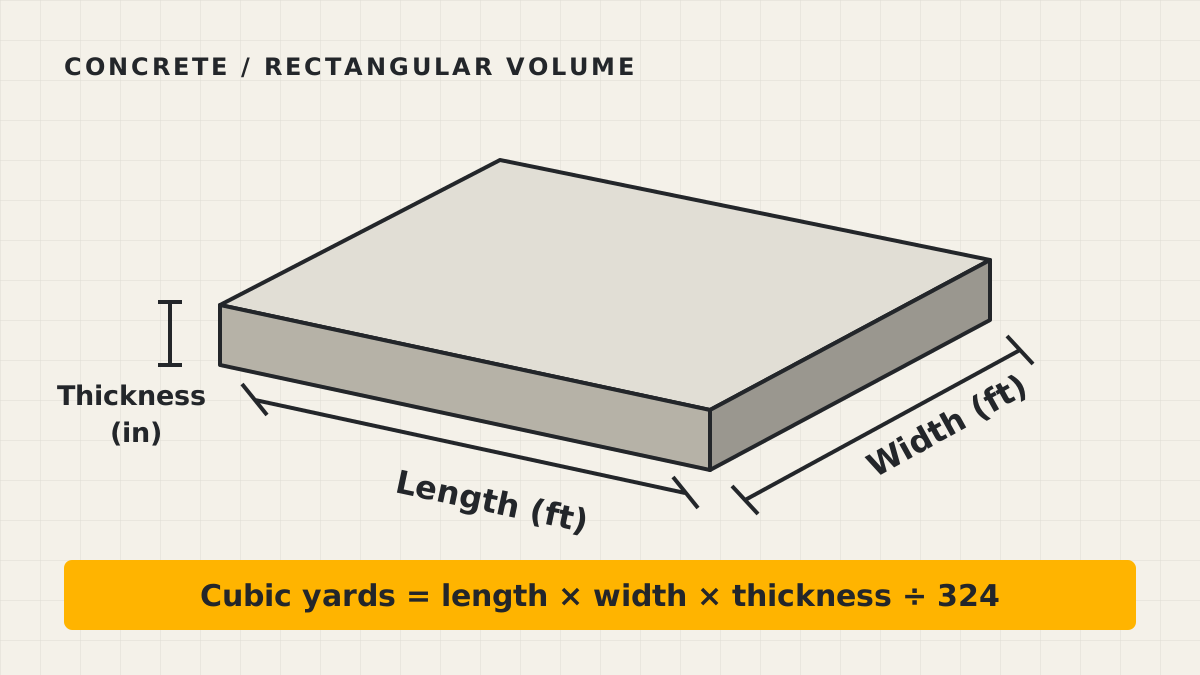
A concrete order needs a quantity, the specified mix, a delivery plan and an agreed price. Use this checklist to collect those details before calling the supplier. It is a purchasing worksheet; the project's designer or specification determines structural requirements.
1. Write down the measured quantity
Split the pour into shapes you can measure. For rectangular areas, use feet for length and width and inches for thickness: cubic yards = length × width × thickness ÷ 324. For round forms, use the cylinder-volume guide.
List thickened sections separately and count only the additional depth if the main slab volume already includes their area. Multiplying every section independently without checking overlap can overstate the order.
| Quantity record | Your job |
|---|---|
| Drawing or measurement revision | ______ |
| Main measured volume, yd³ | ______ |
| Additional non-overlapping sections, yd³ | ______ |
| Total measured volume, yd³ | ______ |
| Agreed allowance and reason | ______ |
| Planned order volume, yd³ | ______ |
| Supplier's billable quantity, yd³ | ______ |
The concrete calculator already displays an allowance. Check its output before adding another. An allowance is a planning assumption, not a substitute for measuring the actual excavation and forms.
2. Check sensitivity to thickness
A 20 ft × 20 ft area at a specified 4-inch thickness contains 20 × 20 × 4 ÷ 324 = 4.9383 yd³. If the actual average fill depth is 4.5 inches, it contains 20 × 20 × 4.5 ÷ 324 = 5.5556 yd³.
That extra half inch adds 0.6173 yd³, or 12.5%, before allowance. This is a quantity example, not a recommendation for slab thickness. It shows why an uneven base can consume more concrete than a flat drawing suggests.
3. Have the mix specification available
Give the supplier the approved project requirements and ask them to resolve any missing details before confirming the order. Record the specification reference, intended use and any requirements the designer has set for strength, durability, aggregate, consistency or other properties.
NRMCA's guide to ordering ready mixed concrete explains why the order should communicate the required concrete properties and intended conditions. Avoid reducing the whole specification to a single PSI number.
4. Agree delivery and placement details
- Delivery address, site contact and a reachable phone number recorded.
- Delivery date, arrival window and expected placement sequence agreed.
- Access route and truck requirements checked with the supplier.
- Method of moving concrete from discharge point to forms arranged.
- Crew and necessary equipment scheduled for the delivery window.
- Washout arrangements agreed for the site.
- Weather-related changes and cancellation notice discussed.
Use the supplier's actual vehicle requirements. Do not assume a residential driveway, narrow gate or overhead clearance will accommodate the delivery vehicle.
5. Confirm the full quoted price
- Billable yardage and price for the specified mix.
- Delivery and minimum-load charges.
- Included unloading time and additional waiting charges.
- Pump or separate placing-equipment costs, where needed.
- Taxes, surcharges and cancellation terms.
- Written quotation or order reference saved.
If comparing supply methods, use the ready-mix versus bagged worksheet so both prices include handling and equipment.
Copyable supplier enquiry
“Please quote for [quantity] cubic yards for [project/use] at [address] on [date]. The specified mix requirements are [specification/reference]. Access and discharge arrangements are [details]. Please confirm billable quantity, delivery and minimum-load charges, included unloading time, other fees and cancellation terms.”
Keep the reply beside your measurement worksheet. If dimensions, specification or delivery arrangements change, update the order and ask the supplier to confirm the revised details.
Use the related US tools
Check the next part of your estimate
How to Calculate Concrete in Cubic Yards
Calculate slab concrete from feet and inches, convert cubic feet to yards, and check a 20-by-12-foot example with the allowance shown separately.
Ready-Mix vs Bagged Concrete: Compare the Whole Job Cost
Compare bagged and delivered concrete using volume, bag yield, labor, equipment and supplier fees. Includes a worked 1-cubic-yard cost worksheet.
Concrete for Round Forms and Post Holes: Yard and Bag Guide
Estimate concrete for cylindrical forms and post holes from diameter and fill depth, subtract post displacement, and convert the volume into bags.